
Arabic Marketing Glossary
What Is a Dialect Product Ad?
A dialect product ad pairs your real product photo with a caption in your customer's Arabic dialect. See how it works, four dialect examples and a checklist.
Written byShadi Al MilhemFounder of Lahjty
Last updated:
Short Answer
A dialect product ad is a social media ad that a small seller makes from a real product photo or store listing. The ad image shows the actual product with its label and packaging unchanged, and the caption is written in the customer's Arabic dialect, with an optional voiceover. Lahjty (لهجتي) is one tool that makes them.
Quick Facts
- Made from
- A real product photo, a product link, or a store import from Salla, Zid, Shopify or WooCommerce.
- What you get
- An ad image with the real product, a caption and headline in the customer's dialect, and an optional voiceover.
- Common sizes
- 4:5 or 1:1 for feed posts, and 9:16 for stories, reels, TikTok and Snapchat.
How it differs from translation and from generic AI images
A translated ad keeps the English sentence and swaps its words, so it often reads stiff. A dialect product ad is written from the start the way buyers in one market speak. A generic AI image is different too: ask an image model for “a perfume bottle” and it invents one, often with a misspelled label. The customer must receive the item they saw, so the seller's own photo stays the source of truth.
- Translation changes the words; dialect copy changes how the product is presented.
- A generic AI image invents a product; a product ad keeps the one you sell.
What makes a dialect product ad work
Four details decide whether the ad earns the customer's trust or gets scrolled past.
- Dialect: one market per version. Saudi buyers read Saudi Arabic and Egyptian buyers read Egyptian, never a blend.
- Offer facts: price, discount, last day and conditions match the store exactly, with no rounding and no invented urgency.
- Platform size: 4:5 or 1:1 for feed posts, 9:16 for stories, reels, TikTok and Snapchat.
- Label spelling: the product name is written exactly as printed on the packaging, in the image and the caption.
Worked example: one perfume, four dialects
SAHRA OUD is a fictional oud perfume from Lahjty's examples. The ad image changes only the scene around the bottle, and the caption is rewritten for each market while the product name stays as printed.
- Saudi
- وش رايك بعطر يثبت معك طول اليوم؟ SAHRA OUD ريحته فخمة مرة. اطلبه الحين
- Saudi markers: wesh (what), marra (very), al-heen (now).
- Emirati
- عطر يدوم وياك من الصبح لين الليل. SAHRA OUD ريحته وايد فخمة، شو تنتظر؟ اطلبه الحين
- Emirati markers: wayed (very), shu (what), wiyak (with you).
- Egyptian
- إزاي ريحتك تفضل حلوة طول اليوم؟ SAHRA OUD عطر عود ثابت أوي. اطلبه دلوقتي
- Egyptian markers: ezzay (how), awi (very), dilwa'ti (now).
- Levantine
- شو في أحلى من ريحة بتضل معك طول النهار؟ SAHRA OUD عطر عود ثابت كتير. اطلبه هلّق
- Levantine markers: shu (what), ktir (very), halla' (now).
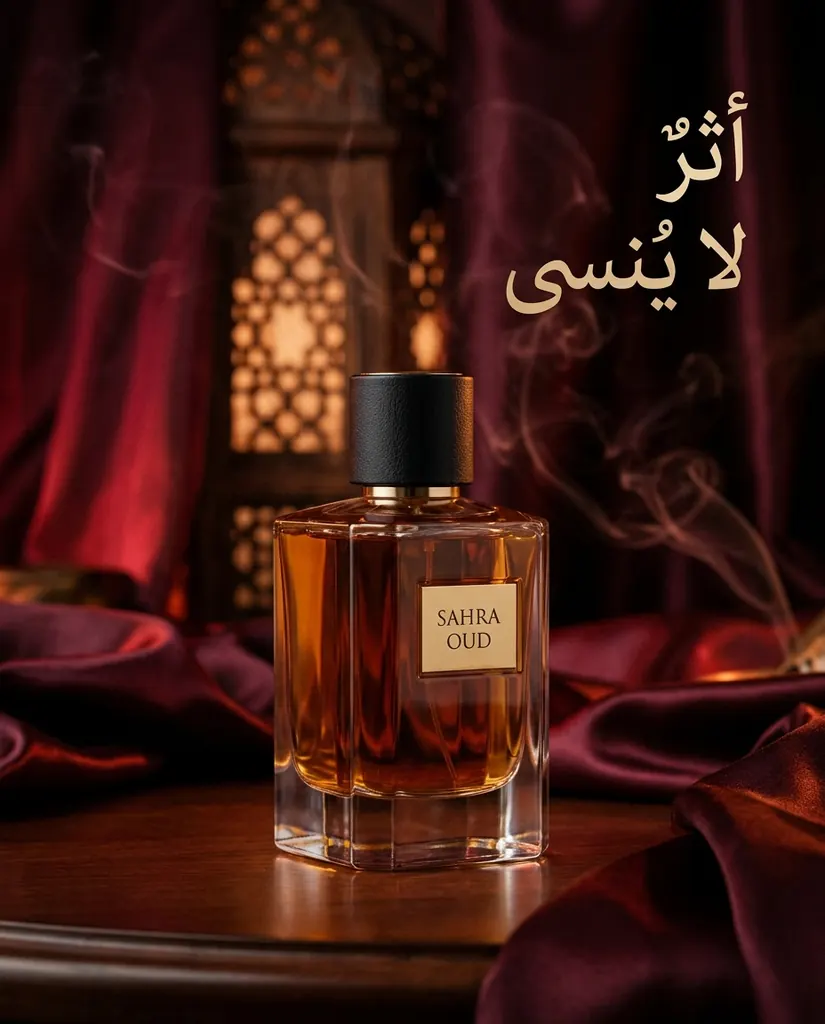
Checklist before you post
Look at the finished ad on your phone, the way a customer will see it, and confirm each point.
- The product in the image is the one you ship: same shape, color, label and packaging.
- The product name is spelled exactly as on the label.
- The caption uses one dialect that matches your target market.
- Every price, discount, code and date matches your store today.
- The image size fits the placement.
- Arabic text on the image has joined letters and reads right to left.
- Any voiceover uses the caption's dialect and offer.
How Lahjty makes one
Upload a product photo, paste a product link, or import your Salla, Zid, Shopify or WooCommerce store, then pick the dialect and platform. Lahjty builds the ad image around your photo, writes the caption and headline in Saudi, Emirati, Egyptian, Levantine or Iraqi Arabic, Fus'ha or English, and can add a voiceover. Each new ad image is read back before it is saved. If its text or product is still wrong after one redraw, it is not saved and your credits come back.
Related Guides
Useful Lahjty Tools
FAQ
Is a dialect product ad the same as a translated ad?
No. A translated ad swaps the words of a source sentence. A dialect product ad is written for one market from the start, so a Saudi customer reads Saudi Arabic and an Egyptian customer reads Egyptian, with the same product and offer facts in both.
Can AI change how my product looks?
A general image model can, because it draws the product from a description. A product ad tool should build the scene around your own photo and keep the label, logo and packaging. Lahjty compares each new ad image with your photo and does not save one that is still wrong after a redraw.
Which image sizes should a product ad use?
Use 4:5 or 1:1 for Instagram and Facebook feed posts, and 9:16 for stories, reels, TikTok and Snapchat. Keep the product and any text away from the edges, where app buttons and the caption can cover the image.
Do I need a voiceover?
No, it is optional, but it suits video placements such as reels, TikTok and Snapchat. Use a voice in the caption's dialect so the ad sounds like one message. Lahjty has Saudi, Gulf, Emirati, Egyptian, Levantine and Fus'ha voices.
Can I try it on my own product?
Yes. A new Lahjty account includes free credits for your first 3 ad images, with no card needed, to test on your own product photo.